Guaranteed freedom of the press in Germany
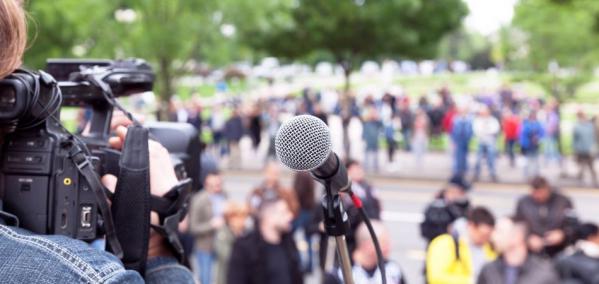
A free press is one of the most important prerequisites for a democracy. In Germany, this is protected by the Basic Law The Basic Law The Basic Law determines that Germany is a constitutional state: All state authorities are subject to judicial control. Section 1 of the Basic Law is of particular relevance. It stipulates that respect for human dignity is the most important aspect of the constitution: “Human dignity shall be… Read more › . Article 5 describes freedom of opinion and the press as: “Every person shall have the right freely to express and disseminate his opinions in speech, writing and pictures and to inform himself without hindrance from generally accessible sources. (. . .) There shall be no censorship.”
How many newspapers are there in Germany?
The lifeblood of press freedom is a diverse media landscape. People in Germany can find information in sources of all kinds and form their own opinions. The press is not controlled by governments or parties. Instead, media companies are funded through private enterprise. Germany has the world’s fifth-largest newspaper market, after China, India, Japan and the US. Currently, the media landscape comprises around 330 newspapers with more than 660 different titles. This huge variety and a daily circulation of more than 12 million make Germany Europe’s largest newspaper market. In its World Press Freedom Index, the nongovernmental organisation Reporters Without Borders ranked Germany eleventh out of 180 countries in 2025.
Media use in Germany
Digitalisation has brought about a marked shift in the media that Germans can access. German newspapers sell more than 2.9 million digital editions per day of publication, around 60 percent of this total to subscribers. Growing by around eight percent per year, digital newspapers are accounting for an increasingly important share of total circulation. Media consumption has also changed significantly: nearly everyone in Germany uses the internet at least on rare occasions - this even applies to 100 percent of the 14 to 49 age group. As in many other countries, the digital revolution has brought with it a new understanding of the public sphere, as social media and blogs allow everyone to contribute their opinions to discussions.
How Germany combats fake news and disinformation.
Nevertheless, the media still have a key role, such as when it comes to combating fake news and disinformation. Journalists are responsible for informing the public on the basis of careful research and faithful reporting. Germany’s public service broadcasters have a legal mandate to supply as many people as possible with information, education, advice and entertainment. They follow the British model as corporate bodies funded by licence fees or public entities, and form the second pillar of a dual system built on both public and private services. This principle has essentially remained unchanged since the foundation of the Federal Republic in 1949.