Germany’s commitment to fair and free global trade
Germany is a strong export Export Germany is one of the leading export nations. In 2022 it exported goods and services valued at some 1,576 billion Euros. The balance of foreign trade fort he year posted a surplus of 81 billion Euros. Germany has above all the strong performance of its industry to thank for its strength in exports… Read more › -focused economy with close ties to a network of partners around the world. The Federal Government Federal Government The Federal Government and cabinet is made up of the Federal Chancellor and the Federal Ministers. While the Chancellor holds the power to issue directives, the ministers have departmental powers, meaning that they independently run their respective ministries in the framework of those directives… Read more › is committed to open markets and rule-based trade. Along with promoting a multilateral trade regime, supporting the European Union European Union In 1957, Germany was one of the six founding members of today’s EU, along with France, Italy, Belgium, the Netherlands and Luxembourg. The EU is currently made up of 27 states; the euro is the official currency in 20 of them. For Germany, European integration forms the basis for peace, security and… Read more › ’s ambitious free trade agenda is also a priority. German economic diplomacy rests on key three pillars:
- 225 foreign diplomatic missions
- the offices of the 150 chambers of commerce abroad (AHK) in more than 90 countries, and the delegations and representations of German business worldwide
- the Germany Trade and Invest (GTAI) economic development agency of the Federal Republic of Germany
They provide targeted support to help German SMEs SMEs The German economy is characterized first and foremost by small and medium-sized enterprises as well as the self-employed and the independent professions. Some 99.4 percent of all companies are small and medium-sized enterprises. These are firms with annual sales of below EUR 50 million and a… Read more › gain a foothold in foreign markets.
Germany: championing free trade
Germany is closely involved in shaping how international trade is regulated. For example, it is committed to strengthening and reforming the World Trade Organization ( WTO WTO The World Trade Organization (WTO) was founded in 1995 and serves to implement the existing treaties on international trade. It is likewise a forum for negotiation on liberalizing global trade. In the present Doha round Germany has been expressly championing better integration of the developing… Read more › ), a key element of the rule-based global trade system. In addition, Germany accords high priority to the bilateral free trade agreements (FTA) of the European Union European Union In 1957, Germany was one of the six founding members of today’s EU, along with France, Italy, Belgium, the Netherlands and Luxembourg. The EU is currently made up of 27 states; the euro is the official currency in 20 of them. For Germany, European integration forms the basis for peace, security and… Read more › . The EU has already entered into agreements with 38 partner countries, and FTAs with numerous other countries are set to follow.
EU agreements strengthen global partnerships
Germany’s Federal Government Federal Government The Federal Government and cabinet is made up of the Federal Chancellor and the Federal Ministers. While the Chancellor holds the power to issue directives, the ministers have departmental powers, meaning that they independently run their respective ministries in the framework of those directives… Read more › believes that broadly diversifying its trade relations is the best way to make the country’s economy more competitive and resilient. Free trade agreements that the EU has already concluded with partners in all regions of the world, including Japan, Canada, Kenya, Korea, Vietnam and New Zealand, provide access to new markets and important sources of products such as critical raw materials or technologies.
In addition, Germany supports the following efforts to promote free trade:
- rapid ratification of the EU free trade agreements with Mercosur, Mexico and Indonesia
- implementation and further development of the trade agreement with the United States of America
- swift conclusion of negotiations with India, the United Arab Emirates and the ASEAN states
- resumption of negotiations with Australia
How do German businesses take responsibility?
Respect for and promotion of human rights worldwide plays a central role in German trade policy. At the end of 2016, the German government adopted its National Action Plan for Business and Human Rights Human rights The respect and strengthening of human rights worldwide are a cornerstone of German Federal Government policy. Together with its EU partners it is committed to protecting and continually advancing human rights standards throughout the world. This occurs in close collaboration with the institutions… Read more › (NAP), which is based on the Guiding Principles on Business and Human Rights adopted by the United Nations United Nations The United Nations (UN) has a key role to play in the international system. Germany has been a UN member since 1973. Since joining, Germany has taken on more and more responsibility and is now one of the largest donors and supporters of the United Nations. For example, Germany is the second largest… Read more › (UN) in 2011. Through a set of uniform and verifiable standards, the NAP imposes a responsibility on German businesses to uphold human rights Human rights The respect and strengthening of human rights worldwide are a cornerstone of German Federal Government policy. Together with its EU partners it is committed to protecting and continually advancing human rights standards throughout the world. This occurs in close collaboration with the institutions… Read more › along their global supply chains.
Dialogue formats link business, politics and society
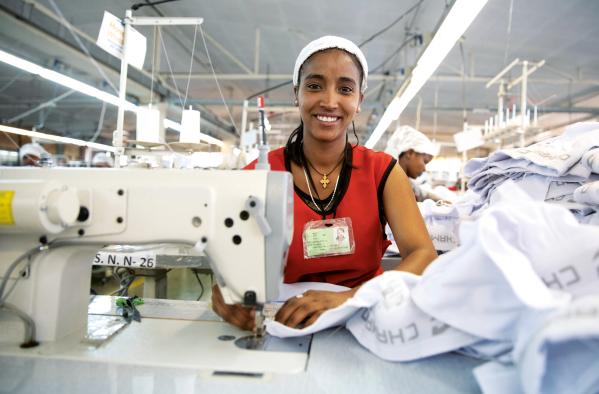
Sector-specific dialogues and initiatives have been developed to help implement the NAP. The automotive industry dialogues, for example, involve businesses, associations and civil society groups, and have proposed wide-ranging recommendations to implement the UN Guiding Principles. Another forum is the Textile Partnership, where the Federal Government Federal Government The Federal Government and cabinet is made up of the Federal Chancellor and the Federal Ministers. While the Chancellor holds the power to issue directives, the ministers have departmental powers, meaning that they independently run their respective ministries in the framework of those directives… Read more › works with NGOs, businesses and trade associations to develop standards for a social, ecological and corruption-free textile and clothing industry.
What does Germany do to promote sustainable supply chains?
The Federal Government Federal Government The Federal Government and cabinet is made up of the Federal Chancellor and the Federal Ministers. While the Chancellor holds the power to issue directives, the ministers have departmental powers, meaning that they independently run their respective ministries in the framework of those directives… Read more › takes action on many levels to ensure equal competition and sustainable supply chains – also with a view to maintaining Germany’s competitiveness. In this context, it cooperates closely with international organisations such as:
- the European Union European Union In 1957, Germany was one of the six founding members of today’s EU, along with France, Italy, Belgium, the Netherlands and Luxembourg. The EU is currently made up of 27 states; the euro is the official currency in 20 of them. For Germany, European integration forms the basis for peace, security and… Read more ›
- the United Nations United Nations The United Nations (UN) has a key role to play in the international system. Germany has been a UN member since 1973. Since joining, Germany has taken on more and more responsibility and is now one of the largest donors and supporters of the United Nations. For example, Germany is the second largest… Read more ›
- the International Labour Organization (ILO)
- the Organisation for Economic Co-operation and Development (OECD)
Furthermore, Germany plays an active role in multilateral forums such as the G7, the G20 and the Asia-Europe Meeting (ASEM). It places especial emphasis in this context on the responsibility German businesses have for their supply chains - though without overburdening them with bureaucracy in the form of reporting duties.
In 2021, the Bundestag The Bundestag The Bundestag is made up of the elected representatives of the German people. In principle elections to the Bundestag are proportionally representative, with each party’s share of the vote in the election reflecting the number of seats it occupies in the parliament. But the electoral system also… Read more › adopted the Act on Corporate Due Diligence Obligations in Supply Chains (LkSG), which for the first time lays down the responsibility that businesses have to uphold human rights Human rights The respect and strengthening of human rights worldwide are a cornerstone of German Federal Government policy. Together with its EU partners it is committed to protecting and continually advancing human rights standards throughout the world. This occurs in close collaboration with the institutions… Read more › and protect the environment in supply chains. Until such time as it is superseded by an act that transposes the European Corporate Sustainability Due Diligence Directive (CSDDD) into national law, the LkSG will remain in force in modified form. During this transitional period, the LkSG will be amended to reduce the administrative burden on businesses and simplify its implementation in everyday life.